Why I Built This
The LODHI-A didn’t start as a project. It started as a frustration.
The Problem
When I began conducting adult ADHD evaluations in private practice, I did what most of us do. I reached for the available tools. The various structured and semi-structured interviews that the field had developed over the years. I expected them to work. They are, after all, well-validated and widely cited. (For a detailed head-to-head breakdown of how these instruments compare, see the instrument comparison.)
But I kept noticing the same pattern. I would read a DSM-5 criterion aloud, sometimes nearly verbatim, and the patient would nod. I would provide an example, and they would agree with it. The instrument was doing most of the diagnostic work, and the patient was along for the ride. By the end of the interview, we had confirmed what the patient already believed coming in, but I wasn’t sure we had actually discovered anything.
The instruments weren’t evaluating the patient. They were feeding the patient the answers.
This is not a trivial problem. When a structured interview walks a patient through each criterion with supplied examples, it creates a recognition task, not a recall task. The patient doesn’t need to generate evidence of impairment from their own life. They just need to say yes. And most people, whether they have ADHD or not, can recognize themselves in broadly worded descriptions of inattention and disorganization.
What Was Missing
The more evaluations I conducted, the clearer the gaps became. Existing tools shared a common architecture: take the DSM-5 criteria, reformat them as questions, and check the boxes. Some added collateral informant forms. Some included childhood recall sections. But the underlying logic was the same: criterion verification rather than clinical discovery.
None of them began where I believe every ADHD evaluation should begin: Why are you here today, and why now? A 38-year-old executive who is suddenly seeking an ADHD diagnosis after two decades of professional success is a fundamentally different clinical scenario than a 24-year-old graduate student who has struggled since childhood. The “why now” question often reveals more about the diagnosis than any symptom checklist.
None of them were designed to catch the high-functioning adult whose intelligence and work ethic have been compensating for ADHD symptoms for years. The patient who doesn’t look like they have ADHD on paper, but who is burning through enormous cognitive resources just to keep up.
And none of them were equipped to do the opposite: to respectfully but rigorously evaluate the patient who arrives already certain of the diagnosis. The patient who has done their research. Who has reinterpreted years of their life through the lens of ADHD, and the narrative makes sense to them. They are not faking. They are genuinely struggling. But when asked to produce concrete, specific examples of impairment rather than endorse the criteria they already know, the picture often shifts. What looked like inattention turns out to be anxiety. What looked like executive dysfunction turns out to be poor sleep, or depression, or the residue of unprocessed trauma. An instrument that walks through a checklist will never surface any of this. It will simply confirm what the patient came in believing. (For more on how the LODHI-A handles these overlapping presentations, see the Specific Populations FAQ.)
And finally, none of them treated the evaluation itself as a therapeutic encounter. In existing tools, the interview is a data collection exercise. But for the patient sitting across from you, someone who may have spent years wondering why everything feels harder than it should, the evaluation is often one of the most important conversations of their life. It deserves to feel like one.
Built in a Clinic, Not a Lab
I didn’t develop the LODHI-A in a research lab. I developed it in my clinic, one evaluation at a time, refining the approach over hundreds of patient encounters. Every module, every probe, every transition in the interview exists because it solved a real clinical problem I was encountering with real patients.
Research instruments are optimized for inter-rater reliability and psychometric properties. Those are important goals, but they produce tools that prioritize standardization over clinical nuance. The LODHI-A is optimized for something different: diagnostic accuracy in the hands of a skilled clinician working with a complex patient.
Conversational Forensics
Questions flow as a clinical conversation while simultaneously building rapport, eliciting diagnostic data, detecting compensation, and surfacing differential considerations. The patient tells their story; the clinician gathers evidence.
Temporal Triangulation
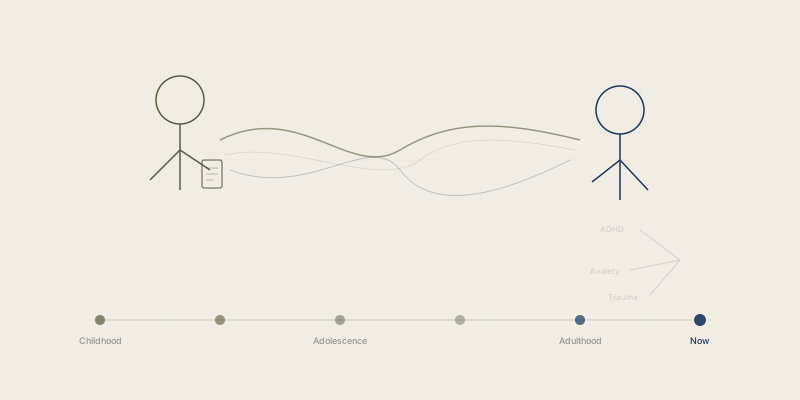
The same functional domains are revisited across childhood, adolescence, early adulthood, and current life. A consistent longitudinal trajectory is the strongest evidence for ADHD; inconsistency across periods is itself diagnostic.
Functional Specificity
Every symptom claim is grounded in concrete, patient-generated examples. Endorsing criteria is easy; documenting the real-world consequences across multiple life domains is what separates disorder from normal variation.
Compensation Detection
Many adults present with extensive scaffolding that has masked executive dysfunction for decades. The interview probes systems, workarounds, and the cost of maintaining apparent functionality, because compensation is what explains how disability hides.
The result is an instrument that does what I believe a good structured interview should do: it makes the clinician’s job easier while making the diagnosis more rigorous. It creates space for the patient to tell their story while ensuring that story is evaluated against the full complexity of the differential. And it treats the evaluation as the beginning of a therapeutic relationship, not just a gate to a prescription.
The LODHI-A is a clinician’s tool. It was built by a clinician who got tired of instruments that didn’t work the way clinical thinking works. If you have ever finished an ADHD evaluation and felt like the instrument led you to a conclusion rather than helping you reach one, this is what I built to fix that.
Neuropsychiatrist · Bay Area Neuropsychiatry
Dual fellowship-trained in Neuropsychiatry and Forensic Psychiatry
See how the LODHI-A compares to the DIVA-5, ACE+, and ASRS. Read the full FAQ for detailed methodology and clinical use guidance. Or request access to the instrument.